
The Church at Presles
The Church at Presles, One of the rare landscapes painted by Mary Cassatt.
Mary Cassatt is best known as a painter of portraits and maternal scenes rather than landscapes. In her correspondence, she herself acknowledged that she was not a landscape painter.
Letter of January 30, 1894, to Eugenie Heller, written from Villa La Cigaronne in Cap d’Antibes: « (…) Our villa overlooks the sea and the snow-covered mountains in the distance, with olive-covered hills below. I think a good number of American landscape painters are here—the scenery is too panoramic for my taste, but no doubt it could be interpreted artistically by a great man. I have never yet done one to my satisfaction. I am content with a little bit of landscape in the background of my figures.» .
Letter of May 19, 1896, from Beaufresne to Paul Durand-Ruel: « I am settled here for the summer and working hard. I hope to submit a few pastels to you soon. If I were a landscape painter, I would have no trouble finding beautiful subjects. The countryside is lovely, despite the dryness…» .
There are, however, a few exceptions to this. One is her only still life, Vase of Lilacs by the Window (early 1880s, Metropolitan Museum of Art, New York), and two oil paintings depicting a church. In 1970, Adelyn Dohme Breeskin listed these works in her Catalogue Raisonné of the Oils, Pastels, Watercolors, and Drawings of Mary Cassatt under the titles The Church at Jouilly and The Church at Presles, with the references BrCR 206 and BrCR 207 (Br = Breeskin; CR = Catalogue Raisonné).
They are described as follows::
| First painting, reference BrCR206: The Church at Jouilly , c.1892 (with photograph of the painting) | |
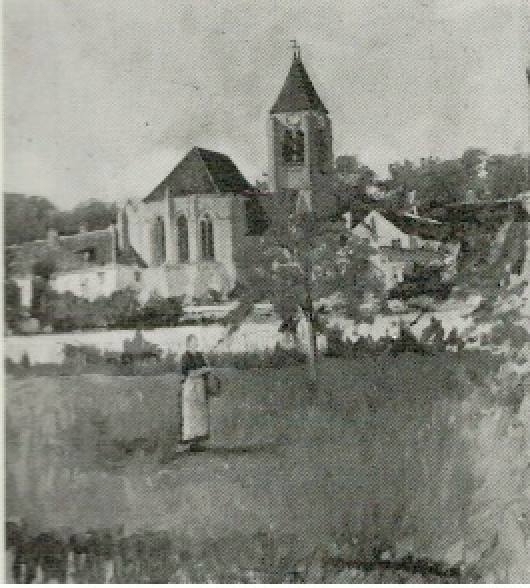 Oil on canvas, 54,7 cm x 65 cm, Signed lower right: Mary Cassatt |
|
| Second painting, reference BrCR207: The Church at Presles , c.1892 (no illustration.) | |
|
Oil on canvas, 73 x 59,5 cm, Unsigned, Mathilde X, collection stamp on verso. |
|
Adelyn Dohme Breeskin dated both paintings to around 1892. However, Mary Cassatt was in Presles in 1885, not in 1892. She spent the summer of 1884 in Viarmes (6 km from Presles) and the summer of 1885 in Presles itself, according to the chronology in Mary Cassatt: Modern Woman, Art Institute of Chicago, 1998–99, p. 338).
In 1892, Cassatt was staying at Villa St. Anne in Cap d’Antibes (January–March), returned to Paris (April–June), then went to Bachivillers to work without interruption until February 1893 on her monumental mural commissioned for the 1893 Chicago world’ Fair which was due to open in May.
Could she have painted the two church scenes at Villa St. Anne or in her Paris apartment at 10 rue de Marignan, using studies she made on-site in 1884 or 1885, before leaving for Bachivillers?
We know that she was very busy in early 1892 with printmaking and with deciding whether to accept the Chicago mural commission, followed by the creation of that enormous work. How could she have found the time to paint two landscapes featuring churches?
Did Breeskin make a mistake in her dating? Might the paintings actually date from 1885 rather than circa 1892?
Given Breeskin’s usual meticulousness, such a wide discrepancy seems improbable. More likely, the confusion arose from Cassatt herself, who rarely dated her works and was known to be careless with chronology.
To resolve the mystery, an on-site investigation was needed.
The church at Presles is well known—but the one at “Jouilly”?
No village by that name exists in France. In the Val-d’Oise, there are only two villages with similar names: Jouy-le-Moutier, about 30 km from Presles (too far away), and Jouy-le-Comte, now a hamlet of Parmain, less than 10 km from Presles. In the neighboring Oise, only Jouy-sous-Thelle might fit, but its church does not match the BrCR206 painting.
On a beautiful Saturday in early autumn 2023, exploration began in Jouy-le-Comte, on the north bank of the Oise. Once there—disappointment! The church’s architecture bore no resemblance to that shown in the BrCR206 illustration from Breeskin’s catalogue.
The journey continued to Presles. After crossing the Oise at L’Isle-Adam and passing through the forest of the same name, one reaches the village of Presles—which inspired Camille Corot to paint a landscape around 1850 featuring a distant view of the village where the church of Saint-Germain-l’Auxerrois is visible, a painting Mary Cassatt may have known and decided to paint as well.
Indeed, the exterior view of the steeple—especially its pointed roof topped by two zinc finials, one with a rooster and the other with a small flag—as well as the church choir with its three large stained-glass windows framed by buttresses crowned with pinnacles, all correspond exactly to the building Mary Cassatt painted with remarkable precision in the BrCR206 painting. The conclusion is inescapable: the painting titled The Church at Jouilly actually depicts the church at Presles.
The only possible photograph today is a close-up, as the open field shown with the peasant woman no longer exists; a modern housing development now blocks any broad view of the church.
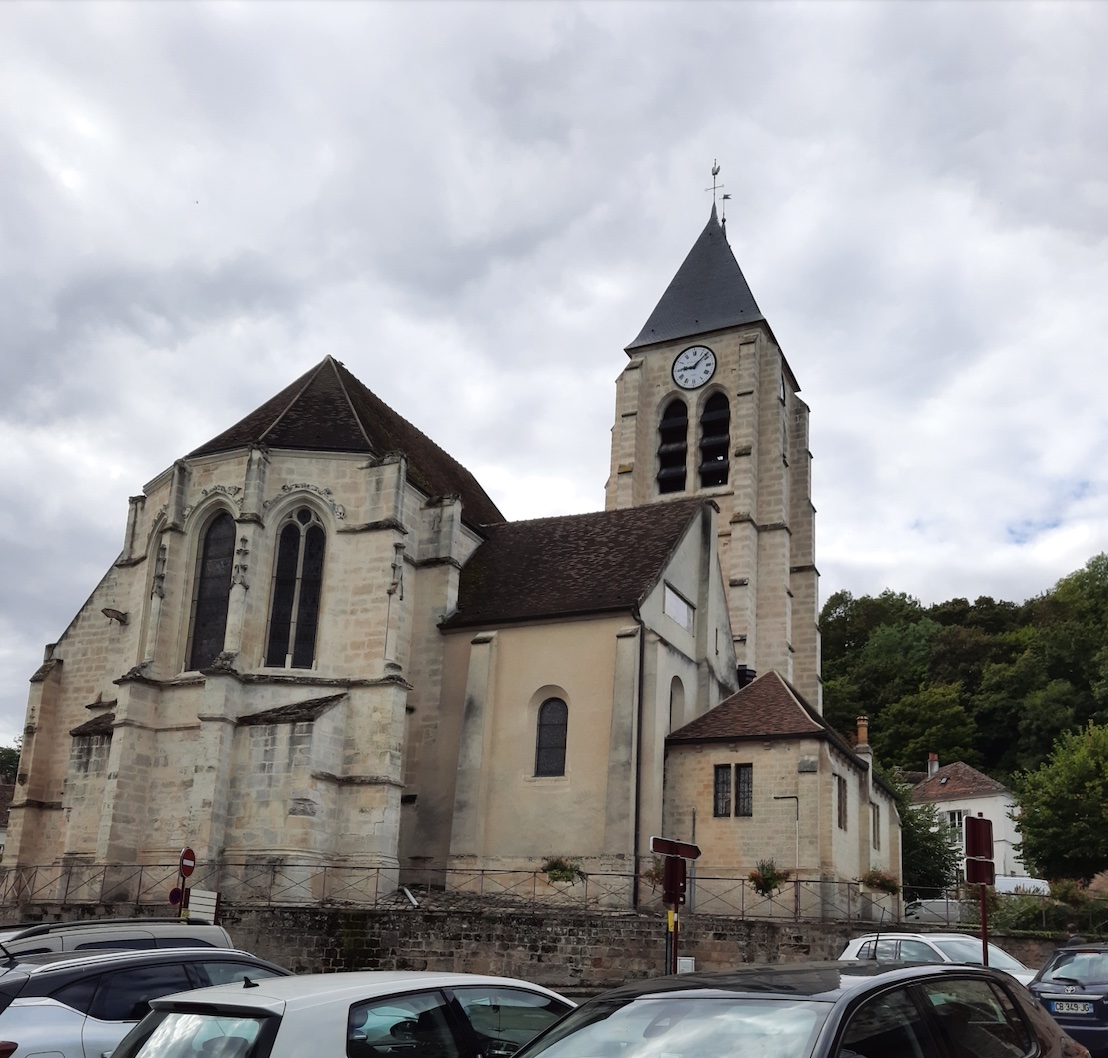 Photograph of the Church at Presles, September 23 2023 |
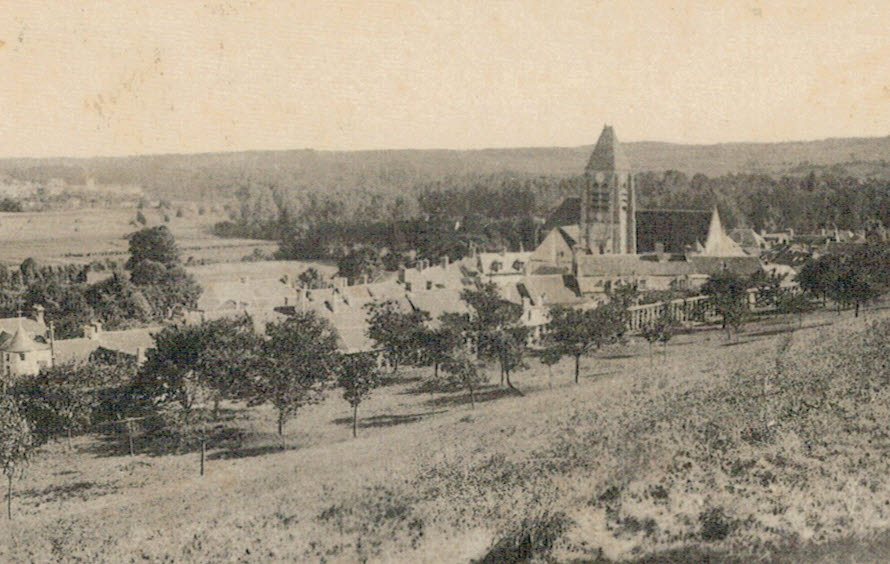 View of Presles around 1900 |
But what, then, can be concluded about painting BrCR207? Without any illustration and with its present location unknown, the second painting remains elusive. Consultation of the 1927 exhibition catalogue of Galerie A.-M. Reitlinger (where it was listed as no. 55) might shed light on it.
We can nevertheless assume that this work—given by Cassatt to her companion Mathilde Valet—was not of major artistic significance. It was likely an oil study of the Presles church, larger in format than the final version. Cassatt had given Mathilde numerous sketches and studies to help her financially after her death.
The conclusion to this engaging investigation is as follows. : “Jouilly” is a mistaken name of unknown origin. The only landscape with a church painted by Mary Cassatt is that of Presles, not of Jouilly—a village that doesn’t exist. Both Breeskin catalogue entries, BrCR 206 and BrCR 207, therefore represent the same subject: the church at Presles, in northern Val-d’Oise.
Michel Chacon, with the participation of Françoise Chacon
September 2023